I built one of my first business websites for a Madison Braille transcription service in 1999. Its existence and what it was for tell me something I didn’t know at the time: I was already doing accessibility work, just without the vocabulary for it.
The site.
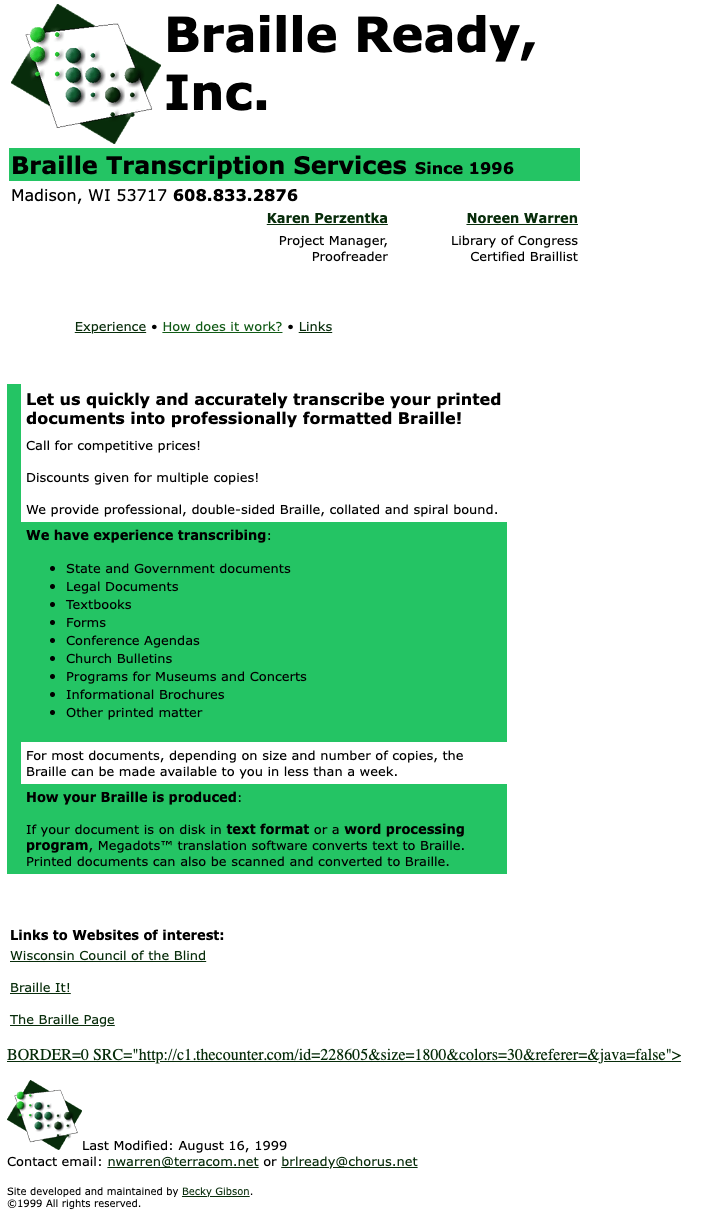
Braille Ready, Inc. transcribed printed documents into double-sided, collated, spiral-bound Braille. State and government documents, legal documents, textbooks, forms, conference agendas, church bulletins, programs for museums and concerts. The shop was in Madison; Karen Perzentka was the project manager and proofreader; Noreen Warren was a Library of Congress certified Braillist. Megadots translation software converted text to Braille from disk; printed documents were scanned. They had been doing this since 1996.
The site lived at userpages.chorus.net/brlready/, a user-pages subdirectory of the local ISP we both had accounts on. I built them a one-page website that looked like every other one-page website from 1999: a green-and-white geometric logo set in a slightly-too-big sans-serif, a table for layout, an image-and-text masthead, three text links in a row separated by middle dots, a phone number in bold, a couple of email addresses you could write to with questions. The footer read “Last Modified: August 16, 1999.” The bottom of the page had a leaked snippet of broken HTML from a TheCounter.com web-stats include that I never got around to fixing. The credit line said the site was “developed and maintained by Becky Gibson.” I went by Becky then.
What it was actually doing.
It was making information available to people who couldn’t read printed pages. That was the whole point of the business and the whole point of the website. The transcribers worked in tactile output; the site worked in screen output; both of them existed because some people read differently than others, and someone had to do the translation work.
I didn’t think of it as accessibility at the time. I thought of it as a Madison small business that needed a site, the same way a chiropractor or a window-washer might. The framework I now use, the WCAG criteria and the audit lanes and the public statement I just published, did not yet exist in any form I would have recognized. WCAG 1.0 was a year old. Screen readers were specialty equipment. The web was for sighted users with broadband, mostly, and that was an unsolved problem nobody was framing as such.
But the business itself was already pointed at the right thing. They were Braille transcribers; my job was to help them get found by people who needed transcription. Whether or not I had the vocabulary, the orientation was there.
What I did with Karen.
Karen and I were friends. Around the time the Braille Ready site went up, she started a job at the Wisconsin Telecommunications Relay Service, where the scripts, SOPs, and weekly memos that made the place run were all printed. There was no accessible version of any of it. I learned to Braille so I could put her own workplace in her hands.
That was accessibility: not a checkbox at the end of a project, not a criterion in a standard, but a friend who couldn’t read her own paperwork and the time it took me to fix that. The website was the visible part of the relationship. The Braille work was the actual work.
The throughline.
Twenty-six years later I am still in Madison, still making websites, and I do this for a living because I take accessibility seriously in the work. The audit tool I shipped recently runs a multi-lane pass over a site and produces an honest report; the /accessibility/ page on bekee.com names the WCAG criteria the audit covers and the ones it does not. The vocabulary is different. The frame is sharper. The motivation is the same: some people need a different way in, and somebody has to do the translation work.
The Braille Ready site has been gone from the live web for years. The Wayback Machine still has the August 1999 capture, which is how I am writing this. Karen is still on the board at Braille Library and Transcribing Services, a steady presence in Madison’s blindness community for decades. The web forgets eventually; the work it documented does not.