No automated violations found on this page for the selected standard. Manual review still recommended.
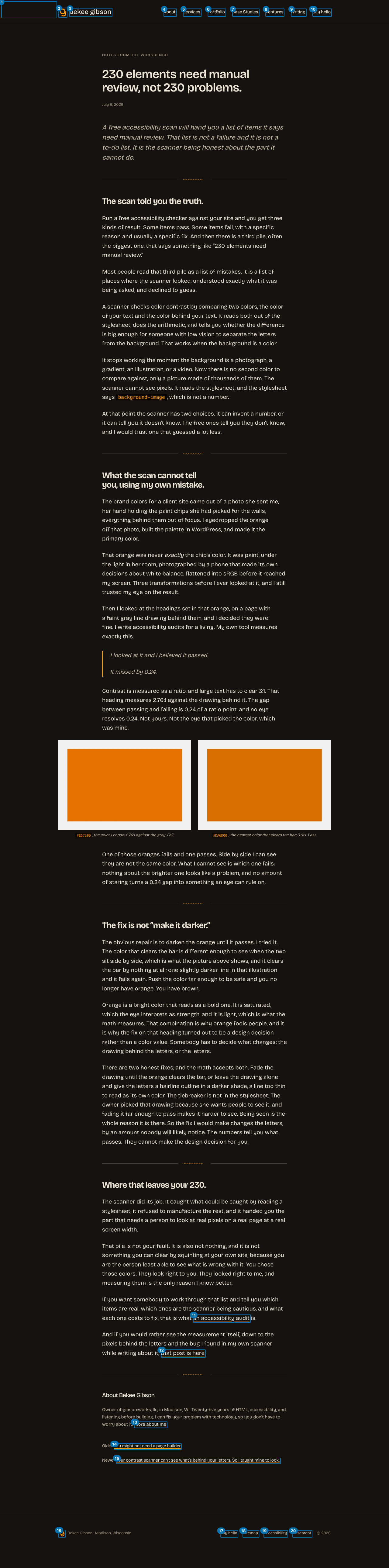
Keyboard and focus order (20 stops)
This is the only lane that drives the page instead of reading it: we pressed Tab and recorded where focus actually landed, until it wrapped. Roles and names come from Chrome's own accessibility tree, the same computation it hands a screen reader. A keyboard user passes 10 stops before reaching main content, and the page has a working skip link.
Nothing in this lane is a failure. The keyboard order was walked end to end and the deterministic checks came back clean.
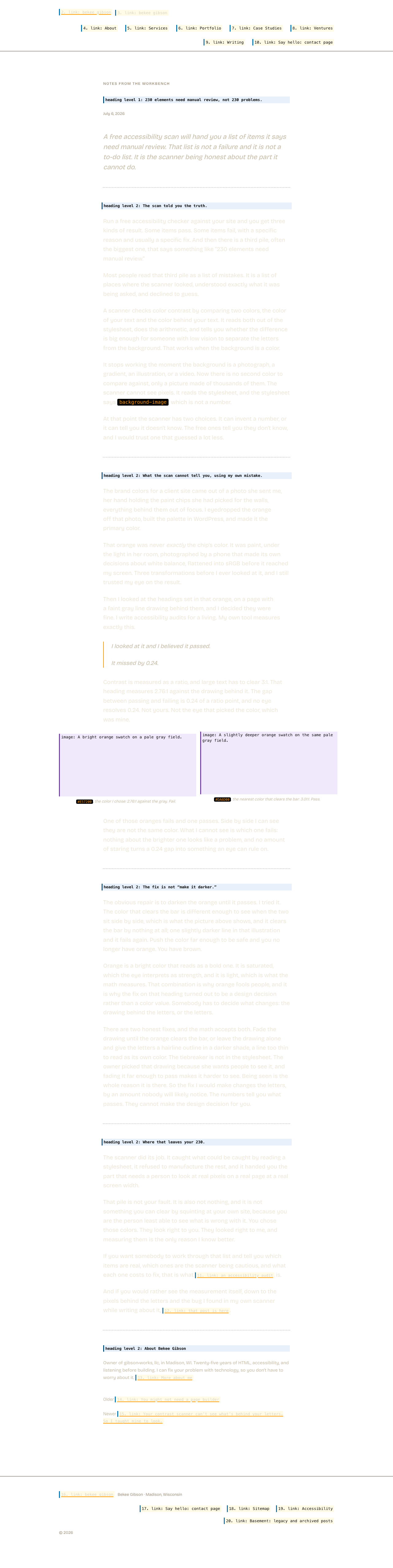
The links list, as a screen reader user gets it 20 links, 17 distinct names
Screen reader users navigate by pulling up every link on the page at once (Insert+F7 in NVDA and JAWS), stripped of the layout that surrounds them. This is that list. Read in place a link can borrow meaning from the heading above it; read here it has only its own name.
Links
All announce as
3
bekee gibson
2
Say hello: contact page
Names appearing more than once, most repeated first. A repeated name is not automatically wrong: a "Home" link in the header and the footer is fine. It matters when the destinations differ and the name does not.
Heading outline, as announced
h1 230 elements need manual review, not 230 problems.
h2 The scan told you the truth.
h2 What the scan cannot tell you, using my own mistake.
h2 The fix is not “make it darker.”
h2 Where that leaves your 230.
h2 About Bekee Gibson
What this looks like on the pageEvery keyboard stop, numbered in the order focus actually visits it. Red marks a stop that is itself a problem.The same layout, showing what is announced instead of what is rendered. Hatched areas carry nothing for a screen reader user: background images, decorative graphics, and media with no text alternative. Interactive elements show the name Chrome computed; everything else is an illustrative approximation, not a finding.
AI-assisted findings (needs human confirmation)
These are judgment calls about link purpose and heading clarity that automated tools cannot make. A model flagged them; confirm before acting.
The link text 'that post is here' does not describe the destination or topic of the linked post. Even with surrounding context explaining the subject (contrast measurement and a scanner bug), 'that post is here' is a generic pointer phrase that fails to identify where the link goes for a screen-reader user scanning links.
Suggested: Use the post title as the link text, for example: 'Measuring the right pixels: the contrast bug I found in my own scanner'